 Jun, 2026
  729 views
  3 min Read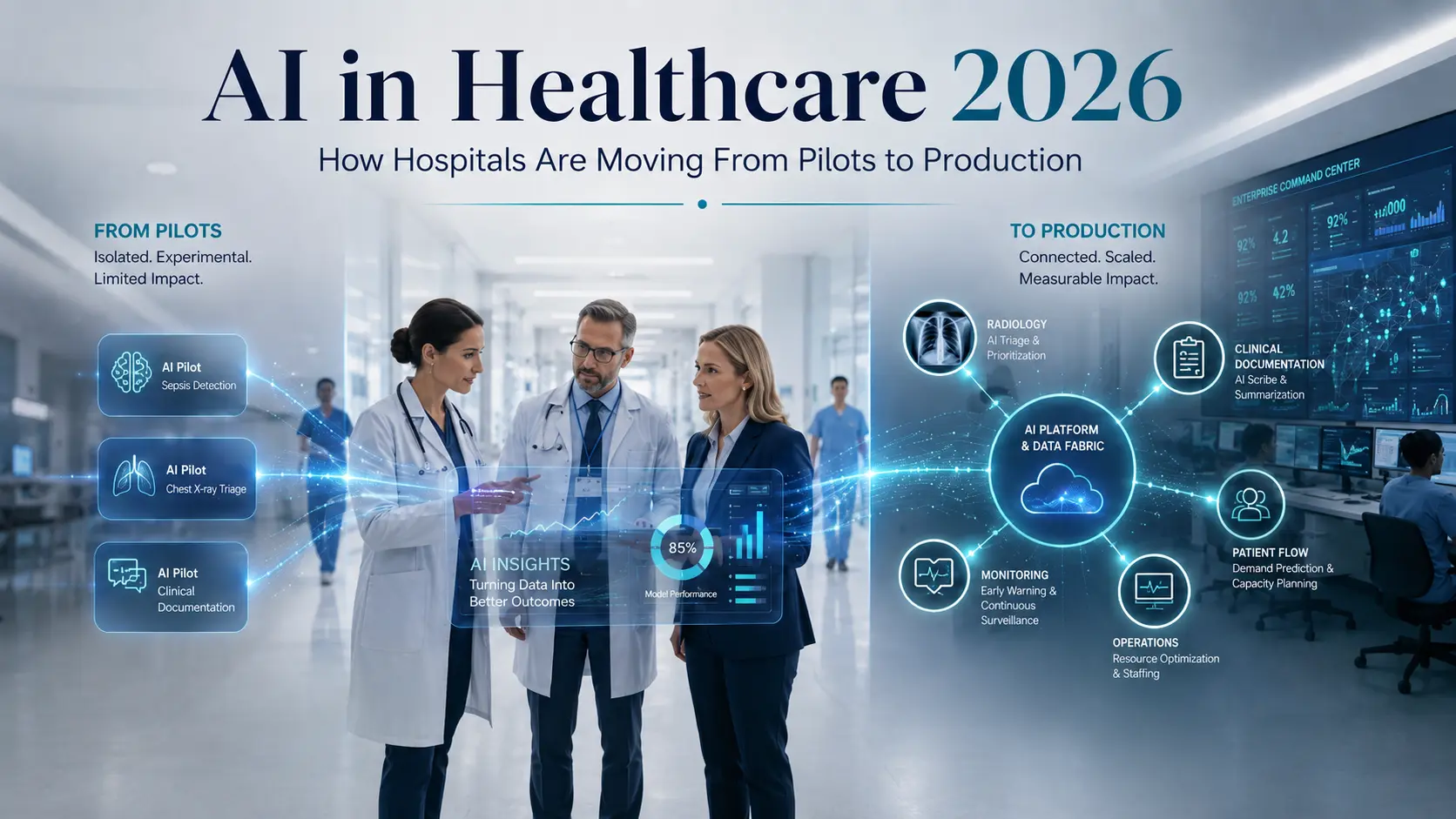
Walk into a healthcare conference in 2026 and you will hear one phrase again and again: agentic AI.
This is not just another chatbot added to a workflow. Agentic AI is beginning to work inside the hospital itself, helping coordinate tasks, prepare patient summaries, flag missing information, support documentation, and move work forward while clinicians remain responsible for final decisions (Philips, 2026).
That is why healthcare leaders are no longer treating AI as a side experiment. At Mount Sinai’s “New Wave of AI in Healthcare” symposium, leaders from Mayo Clinic, Epic, AstraZeneca, and the NIH pointed to the same reality: AI is becoming part of healthcare infrastructure (Mount Sinai Today, 2026).
That shift raises the bar for hospitals.
A pilot can be limited and experimental. Production AI cannot. It has to be reliable, secure, governed, and ready to operate inside real clinical and administrative workflows where delays or errors can have serious consequences.
So the question has changed.
It is no longer, “Can we test AI?”
It is, “Can we run it safely, at scale, every day?”
That is what makes healthcare AI in 2026 different. It is no longer just a proof-of-concept challenge. It is an engineering, integration, and software development challenge for the entire health system.
For years, many clinicians were cautious about using AI in patient care. That started to change when ambient documentation tools showed a clear, practical benefit: helping physicians finish their notes before the end of the workday and reducing the after-hours charting often called “pajama time” (AMA Survey, cited in Tateeda Global, 2026).
This made AI feel less like a top-down technology push and more like a tool clinicians could actually use. Once doctors experienced the time savings and reduced documentation burden, demand began coming from inside the workforce itself.
Patients are also adopting AI quickly. Many now use AI tools to review lab results or doctor’s notes before appointments, often without telling their physician (Chief Healthcare Executive, 2026). This is changing the exam room conversation. Physicians are increasingly being asked to respond to AI-generated information that patients bring with them.
The bigger issue is trust. Patients may be comfortable using AI, but they still want their physician to validate what it says. Clinicians, meanwhile, remain cautious about bias, hallucinations, and unreliable outputs (Wolters Kluwer, 2026).
That trust gap is becoming one of the most important challenges in healthcare AI. The next step is not just building more AI features, but making sure AI can be used safely, clearly, and with clinician oversight.
Ambient scribes were one of the first AI applications to change how clinicians viewed the technology. They offered a clear benefit: less time spent on documentation and more time back in the clinical day.
In 2026, these tools are moving from standalone add-ons into the electronic health record itself. Kaiser Permanente’s rollout of Abridge across dozens of hospitals and hundreds of clinics remains one of the largest generative AI deployments in healthcare. Other large systems have also reported major reductions in after-hours documentation time, along with improvements in physician well-being (Tateeda Global, 2026).
The Department of Veterans Affairs is now expanding ambient scribes to every VA medical center nationwide, making it the largest government healthcare AI deployment in the country (SOAPNoteAI, 2026).
At the same time, major EHR vendors are building this capability directly into their platforms. Epic has shipped more than a hundred AI features, and athenahealth now includes an ambient scribe instead of selling it only as an add-on (Healthcare Dive, 2026).
For health systems, this creates a new decision: build, buy, or integrate. Even when AI features are built into the EHR, hospitals still need custom integration work to make them fit cleanly into existing clinical workflows. That is becoming a major system modernization challenge for healthcare IT teams.
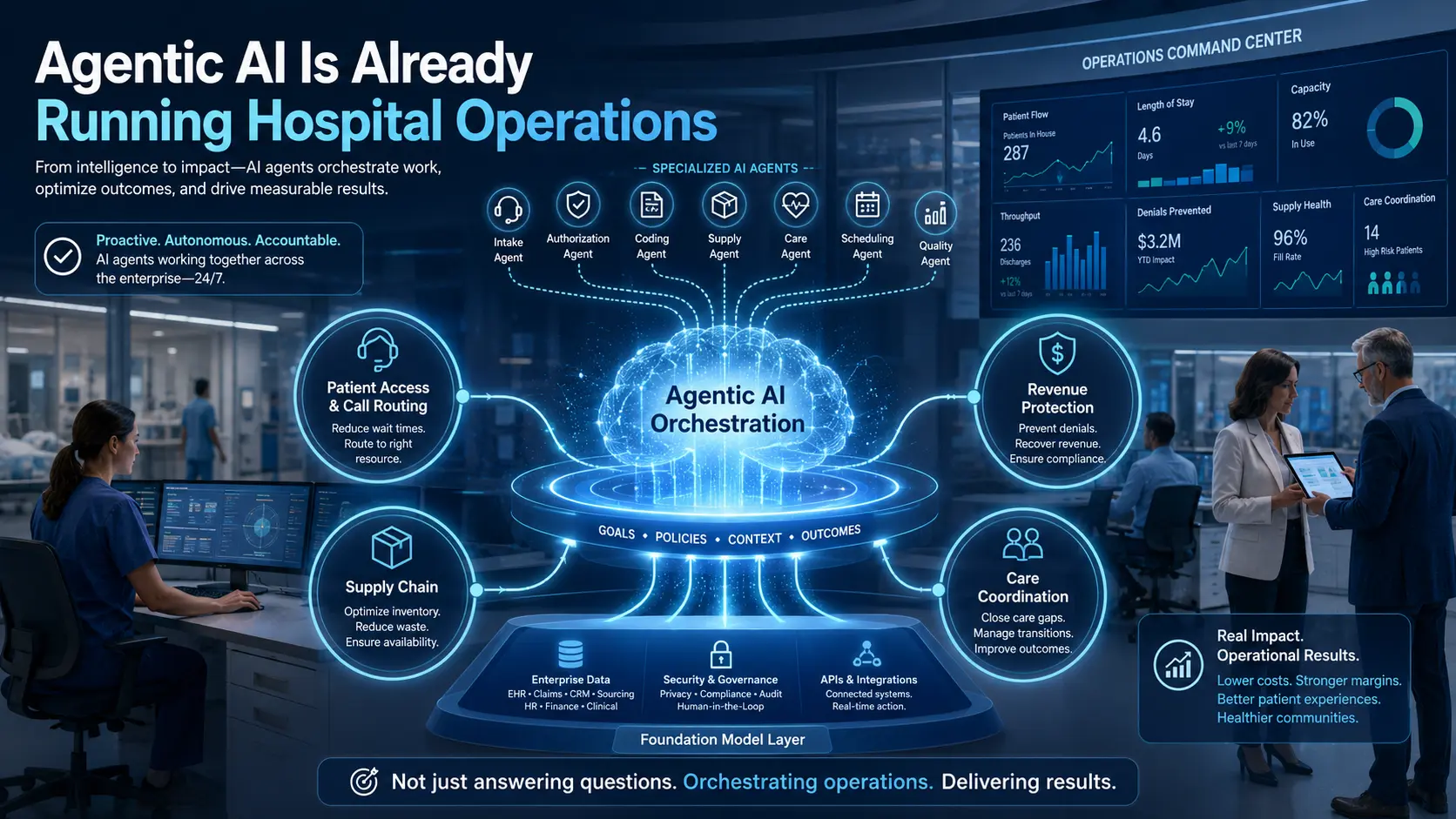
What makes 2026 different from the earlier generative AI wave is that agents are no longer just answering questions. They are beginning to take action.
Mount Sinai and Mayo Clinic are piloting AI agents that automate administrative tasks and help coordinate care across departments. Mount Sinai’s research also found that systems made up of multiple specialized agents can outperform one large model trying to handle everything on its own (Mount Sinai, 2026).
That matters because the next leap in healthcare AI may not come from simply using a bigger model. It may come from how well different agents are designed, connected, and orchestrated
The early use cases are practical rather than flashy:
- Call routing and patient access: CommonSpirit Health is using an internally built AI agent across virtual command centers to replace legacy phone trees and automate call routing.
- Revenue protection: Mount Sinai has deployed agents that scan contract and billing data to identify underpayments and denials before they become losses (Mount Sinai, 2026).
- Supply chain: Mayo Clinic and Mount Sinai are applying agentic AI to surgical supply chain costs (Modern Healthcare, 2026).
- Foundation-model choices are also becoming more strategic. Banner Health rolled out a private internal chatbot built on Anthropic’s Claude across its 33-hospital system, while Hackensack Meridian Health chose a Google Gemini-based agent (Becker’s Hospital Review, 2026).
- For health systems, choosing a foundation-model partner is starting to look more like choosing an EHR vendor. That decision can shape the custom tools, integrations, and AI-enabled applications they build next.
Radiology remains one of the clearest areas where AI is moving from “nice to have” to real clinical impact. A large Swedish trial published in Nature Medicine found higher cancer detection rates with AI-supported mammography screening compared to standard practice (Nature Medicine, 2024).
In 2026, the bigger change is integration:
- Triage: AI flags urgent scans and moves them higher in the worklist.
- Measurement: AI-supported tools complete key measurements before the radiologist opens the study.
- Reporting: Structured reports flow into referral and billing workflows instead of staying isolated in a point solution.
Remote patient monitoring is seeing a similar shift. Instead of flooding care teams with alerts, AI filters the noise and highlights patients whose trends suggest real deterioration risk. Virtual ward programs for heart failure and COPD have reported lower 30-day readmission rates, according to a 2025 meta-analysis in the European Journal of Heart Failure.
Drug discovery is slower moving, but potentially higher stakes. Insilico Medicine advanced a generative AI-designed pulmonary fibrosis drug from target discovery to Phase I trials in about 18 months, compared with a conventional timeline of five years or more (ScienceDirect, 2026). DeepMind’s AlphaFold continues to support faster discovery across the field.
The caveat remains: no AI-native drug has yet completed full regulatory approval for widespread use. Phase III results over the next two years will be the real test.
Not every AI story in healthcare is about clinical breakthroughs. A lot of the value being captured right now is administrative, and one of the more interesting emerging use cases is drug diversion detection, catching theft or misuse of medications by healthcare workers before it causes harm. Most healthcare leaders openly admit they don't have much confidence in their current diversion-prevention programs, largely because catching the pattern requires reviewing far more records than any human team can realistically get through (Wolters Kluwer, 2026).
AI pattern recognition applied to this problem is exactly the kind of unglamorous, high-leverage application that doesn't make headlines but quietly protects both patients and staff.
This sits alongside the broader workforce story that's been building for years. Clinician shortages are structural, administrative burden eats a meaningful share of physician time, and the system can't simply hire its way out of the problem. AI is increasingly absorbing the parts of the job that don't require clinical judgment, documentation, coding, scheduling, prior authorization, and follow-up outreach, freeing up the people qualified to do the things AI still can't.
During the pilot phase, many health systems adopted fifteen or twenty separate AI tools for different use cases. Now, they are trying to reduce that complexity and work with fewer, more complete platforms. Ambient documentation is one area where this shift is especially visible, with more mergers expected as vendors move beyond single-feature tools (Healthcare Dive, 2026).
Large EHR vendors such as Epic and Oracle Health have a clear advantage because their AI tools are built directly into the systems clinicians already use. For many hospitals, that makes adoption easier, even when a smaller vendor may offer a stronger standalone product.
At the same time, regulation is still catching up. Mount Sinai’s healthcare AI policy index found that governance is growing quickly, but remains fragmented across regulators, governments, and standards bodies (Mount Sinai, 2026).
The EU AI Act, which takes full effect in August 2026, classifies medical AI as high-risk and requires transparency and human oversight. Liability also remains unclear when an AI-assisted decision leads to harm, and many patients still do not know when AI has played a role in their care Hastings Center for Bioethics, 2026).
This does not mean health systems should slow down. It means they need to build carefully. AI in healthcare now requires the same discipline as any mission-critical system: clear governance, audit trails, compliance, security, and human oversight from the start.
The organizations pulling ahead in 2026 are not the ones with the longest list of AI tools. They are the ones with clean, interoperable data, strong governance, and a habit of building with frontline clinicians rather than imposing technology from the top down.
Mount Sinai’s Girish Nadkarni captured the challenge well at the May symposium: competition and proprietary data can push institutions into silos at the exact moment when healthcare AI needs more collaboration, not less (Mount Sinai Today).
At this point, the evidence that AI can improve healthcare is strong. What is still being built is the evidence that it can be deployed safely, fairly, and consistently across every patient population and every health system, not just the best-resourced ones.
That gap between what AI can do and what healthcare can responsibly trust it to do is the real work left for 2026.