Faster Bank Merger Approvals Make M&A IT Integration the Critical Path
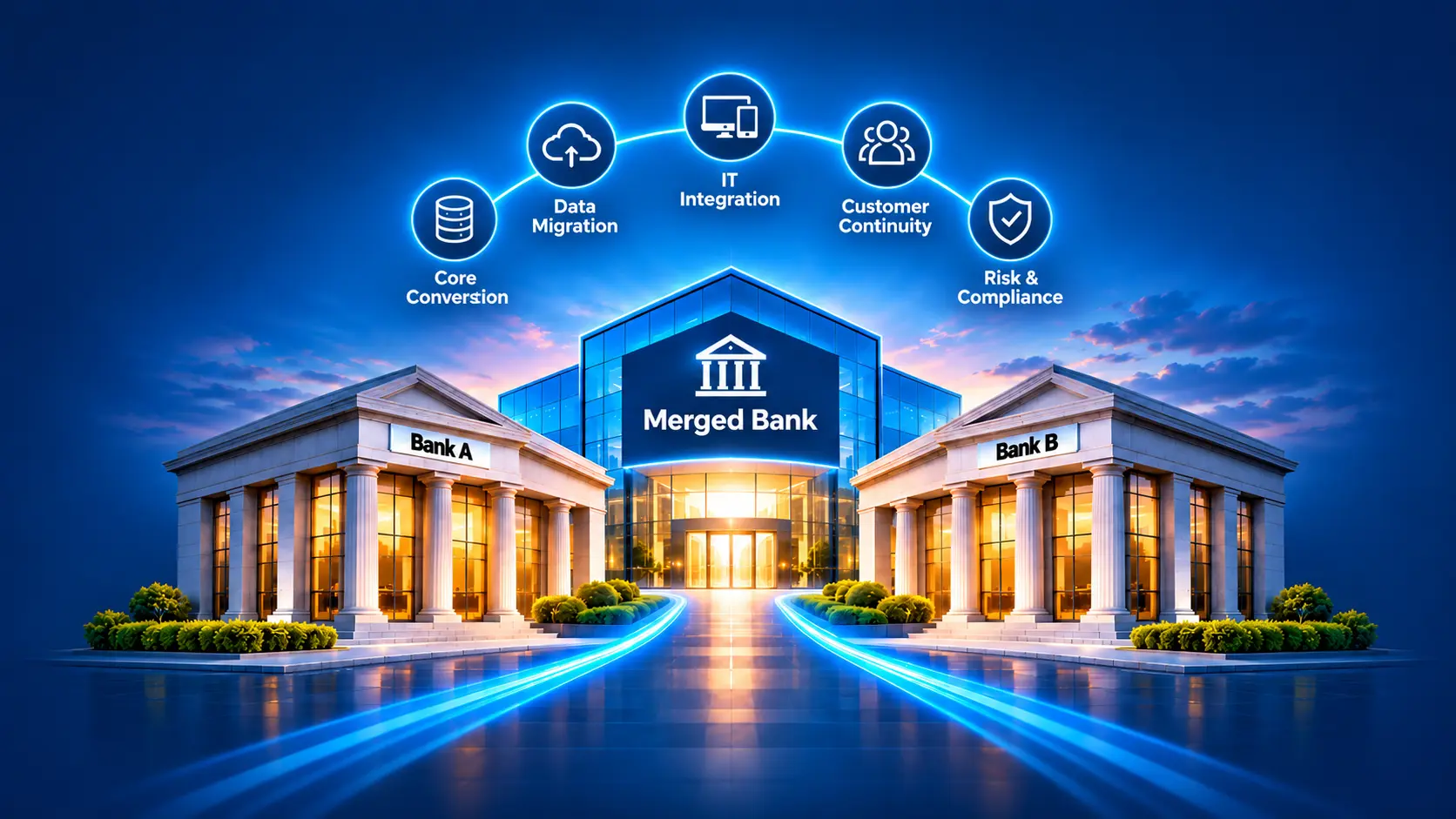
Regulators are approving bank deals faster than they have in years. For community banks on either side of a deal, that moves M&A IT integration, core conversion planning and data migration to before the announcement.
The approval clock has speed up
Bank consolidation has picked up again. Alvarez and Marsal, citing S&P Global data, counted more than 180 bank deals announced in 2025 and reported that the average approval lag fell from about seven months to about four, a pace it described as the fastest in 35 years.
Policy changes are part of the reason. In May 2025 the OCC restored the streamlined application and expedited review procedures that its 2024 rule had removed, and rescinded its 2024 merger policy statement². For acquirers in the Northeast with strategic deals in mind, that is welcome news. It also removes a buffer that many technology teams quietly relied on: the months between announcement and approval that used to absorb IT due diligence, vendor negotiations and conversion design.
Many of the drivers behind these deals are technology drivers: the rising cost of running and securing legacy core platforms, pressure to offer the digital banking experience customers now expect, the compliance burden of maintaining two sets of systems, and the scale needed to invest in core banking modernization. A merger can deliver all of that, but only if the combined bank actually runs on the better platform at the end of the conversion, with its customer data intact. Shorter approvals do not shrink the technical work. They change when it has to begin.
Core system conversion is where customers feel the deal
Customers rarely notice a signing or an approval. They notice the weekend their login changes. Over Labor Day weekend this year, Fifth Third completed the conversion of about 600,000 Comerica customer accounts and 293 banking centers onto its platforms³. In the following days, local reporting described customers who could not log in and who waited hours on hold, and a regional president publicly apologized while noting that most customers had regained access⁴.
Conversions are difficult for every bank, and this was a large program run by an experienced acquirer. The lesson for a community bank is where the strain appeared: digital identity and authentication, contact center capacity and customer communication. These are technology and operations problems more than deal problems, and they are the areas a smaller institution has the least room to absorb.
Commercial clients raise the stakes further. A consumer who cannot log in for a day is frustrated. A business that cannot release payroll, send a wire or reconcile its accounts through its treasury connections is exposed, and it will often have a competing bank calling the same week.
IT due diligence from the target side
Most of the advice on bank conversions is written for the acquirer. The target bank has its own technology work to do, and doing it well protects customers and the value of the deal.
Data quality comes first, because it is the first test of any data migration. Duplicate customer records, incomplete addresses, outdated beneficial ownership files and inconsistent product codes all become conversion errors on the weekend that matters most. Profiling and cleansing that data before the deal is public costs far less than fixing it during the conversion.
System knowledge comes second. The people who know why a fee is waived for a long time customer, or how a particular commercial account is configured in the core, are often the people most likely to leave once a deal is announced. Documenting configurations, custom reports and interfaces, and agreeing on retention for key operations and IT staff through the conversion, is cheap insurance.
Honest disclosure comes third. Tell the acquirer about technical debt, open audit findings, end of life software and fragile integrations. Surprises found during conversion cost more than surprises disclosed during IT due diligence.
M&A IT integration checklist: five things to settle before the deal is announced
With approvals arriving faster, the technical planning that used to happen during the regulatory wait needs to start earlier.
Core banking modernization is the value, not just the cost
PwC’s 2026 M&A Integration Survey found that access to new technologies was an important deal objective for 78 percent of acquirers, and that only about one in three fully achieved their deal thesis objectives⁵. For a community bank buyer, the technology is often the point of the deal: the target’s digital capability, or the combined scale to fund core banking modernization that neither bank could afford alone. Getting the core conversion right is how that value shows up for customers.
The first month after conversion deserves its own plan. Track login success rates, interface and batch job failures, call volumes, hold times, failed payments and complaint themes daily, and publish them to leadership. Keep conversion specialists on hand until those numbers return to normal, not until the calendar says the project is over. Relationship managers should call their largest commercial clients before and after the weekend, because a business that cannot run payroll will remember it longer than any marketing campaign.
Maganti IT has delivered for regulated clients for more than 20 years and holds SOC 2 and ISO 27001 certifications, which matters when the work touches customer data, identity and core systems. Whatever team leads it, an M&A IT integration plan should be written before the deal is public, rehearsed before the weekend, and judged by how the first Monday feels to customers.
If your bank is considering a merger or acquisition, our financial services technology team can assess both technology estates, map the core conversion and plan the data migration before the deal is announced.
Sources
1. Alvarez & Marsal. Surge in Deals and Quicker Approvals Puts Spotlight on Due Diligence, April 2, 2026. https://www.alvarezandmarsal.com/thought-leadership/surge-in-deals-and-quicker-approvals-puts-spotlight-on-due-diligence
2. White & Case. OCC Rescinds 2024 Bank Merger Guidelines, May 12, 2025. https://www.whitecase.com/insight-alert/occ-rescinds-2024-bank-merger-guidelines
3. Fifth Third Bancorp. Fifth Third Completes Comerica Technology and Brand Conversion, September 8, 2026. https://ir.53.com/news/news-details/2026/Fifth-Third-Completes-Comerica-Technology-and-Brand-Conversion/default.aspx
4. WDIV ClickOnDetroit. The Fifth Third, Comerica merger was supposed to be seamless, why many customers say it wasn't, September 13, 2026. https://www.clickondetroit.com/news/local/2026/09/13/the-fifth-third-comerica-merger-was-supposed-to-be-seamless-why-many-customers-say-it-wasnt/
5. PwC. PwC's 2026 M&A Integration Survey, September 29, 2026. https://www.pwc.com/us/en/services/consulting/deals/library/ma-integration-survey.html